How to Organize WhatsApp Messages as Evidence for Court
Organizing a WhatsApp conversation for a court case, family court or small claims: how to keep the original, how to document text messages so they can be read in order, how the content can be certified, and what to give your lawyer.
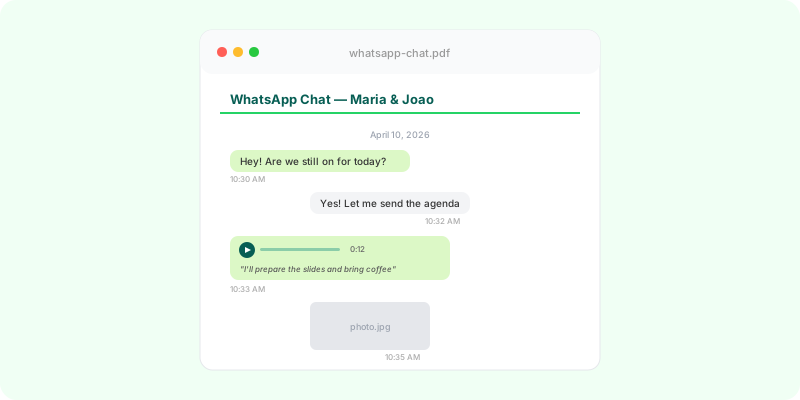
Whether a WhatsApp conversation counts, and how much weight it carries, is decided by the court in your case — the rules vary by country and by type of case, and this page is not legal advice. What you can control is how the conversation is kept and presented. That is what this guide covers.
1. Keep the original #
- Keep the phone the conversation is on, and don’t delete the chat or reinstall WhatsApp.
- Export the whole chat with media (Android: ⋮ → More → Export chat; iPhone: tap the name → Export chat), and keep the
.zipunedited in a safe place. Guides: Android, iPhone. - Keep the whole conversation, not selected messages. A selection invites the question of what was left out.
- Note the other person’s number from the contact info screen: the export shows names as saved in your phone.
Screenshots are fine as a quick note, but they are the easiest form to challenge: an image can be edited and shows only part of the exchange.
2. How the content can be certified #
When authenticity matters — or the other side disputes it — the content is usually confirmed by someone independent:
- A forensic expert can examine the phone or make a forensic copy of it and report on what it contains.
- In India, electronic records are produced with a certificate under Section 63 of the Bharatiya Sakshya Adhiniyam, 2023 (which replaced Section 65B of the Evidence Act from 1 July 2024), in the format set out in the Act’s Schedule — one part signed by the person in charge of the device and one by an expert.
- Elsewhere, your lawyer will know whether a statement, an expert report or a notarial record is the usual route.
3. How to organize the messages #
Whatever the forum — a small claims hearing, family court, a consumer body or a lawyer’s first read — the material is easier to work with when it is organized the same way:
- Decide the period first. Almost no dispute needs the whole chat history. A start and end date turns thousands of messages into the ones that are actually about the matter.
- Keep it continuous inside that period. Cutting individual messages out of a range invites the question of what was removed; cutting by date does not.
- One document, in order, with dates, times and senders on every message. A reader should never have to reconcile a folder of images against a text file.
- Number the pages. This is what lets anyone — you, the other side, the judge — refer to a specific message instead of describing it.
- Don’t leave the voice notes out. If part of what was agreed was spoken, a document that only has the typed messages is missing the part that matters.
- Keep the original. The organized copy is for reading; the export and the phone are what you still hold.
Two forums have their own mechanics on top of this: organizing evidence for small claims court and organizing evidence for family court and custody cases.
4. A readable copy for your lawyer #
A lawyer has to read the conversation before deciding what to do with it — often hundreds of messages and voice notes. Upload the .zip to Zap2Doc and you get a PDF with every message in order with date, time and sender, photos and documents in place, and voice notes transcribed where they were sent, with page numbers to cite. Numbers — amounts, account numbers, dates agreed — appear exactly as they were typed, emoji are drawn rather than dropped, and dates are written the way the conversation writes them. You pick the date range before converting, and most conversations are ready in under a minute. The cover shows the export’s SHA-256, so anyone can check the PDF was made from that exact file. See the PDF explained part by part.
The PDF is a presentation of your export. It isn’t authentication, a forensic report, a chain of custody, a Section 63 certificate or legal advice — it is the copy you and your lawyer read, alongside the original. For the workflow on the lawyer’s side, see organizing WhatsApp chats for lawyers.