How to Organize Evidence for Family Court and Custody Cases
Preparing messages for a family matter: which conversations are yours to use, how to set the period, how to document text messages so a long exchange reads in order, and what to leave to your lawyer.
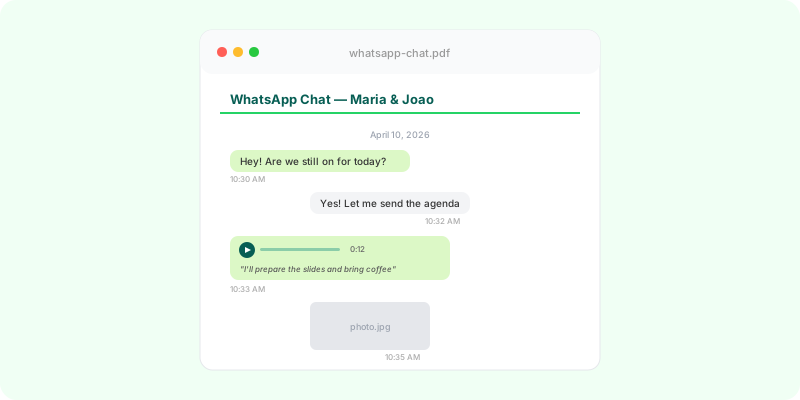
Family matters produce more messages than almost any other kind of dispute: months or years of arrangements, handovers, schedule changes, money, and the difficult exchanges in between. When any of it becomes relevant, the practical problem is rarely that the messages are missing — it is that nobody can read thousands of them in a usable order.
The rules, the forms and the deadlines differ by country and by court, and family proceedings are one of the areas where local procedure matters most. This page is not legal advice: speak to a family lawyer before you file anything, and follow what your court and your lawyer tell you over anything here. What follows is the preparation work that is yours either way.
Use your own conversations, from your own device #
This is the first thing to get right, because it is the one that can go wrong permanently.
- Use chats you took part in, exported from your own phone.
- Do not take messages from the other person’s device, account or backup — depending on where you are, that can be unlawful in itself, and it can change how everything else you bring is received.
- Don’t ask a child to hand over or screenshot their conversations without taking advice first.
- If you believe something on a device that isn’t yours matters, say so to your lawyer and let them advise on the proper route.
Set the period, then keep it whole #
Pick a start date and an end date that match what is actually in issue — the months around a change in arrangements, the period a disagreement covers — and keep everything between them.
The temptation in a family matter is to pull out the twenty worst messages. It usually backfires. A selection invites the question of what the other messages said, and a run of ordinary exchanges around a difficult one is often what shows the pattern in the first place. A date range is defensible; a hand-picked list is not.
Your lawyer may want a wider range than feels comfortable. That is normal: they need to see what the other side will see.
Make it readable in one pass #
A family file is read by people with limited time — your lawyer, and possibly a court. What makes a long exchange usable:
- one continuous document rather than hundreds of screenshots;
- the date, time and sender on every message, because in family matters the timing of a message is frequently the point;
- photos and attachments in place, not in a separate folder;
- voice notes written out, since so much is arranged out loud;
- page numbers, so a specific exchange can be referred to precisely.
WhatsApp’s own export gives you a .txt file plus loose media files, which has none of these. Export the chat with media (Android, iPhone) and upload the .zip to Zap2Doc: you choose the date range, and you get a single PDF with every message in order, photos where they were sent, voice notes transcribed in place, dates written the way the conversation writes them, and page numbers throughout. Most conversations are ready in under a minute. See a sample PDF explained part by part.
If a hearing needs paper, see how to print a chat.
Organize around the questions, not the calendar #
Once the conversation is readable, the useful next step is usually a short summary that points into it — a page listing the dates that matter with the page number for each, written for your lawyer rather than for the court:
- when arrangements were agreed, and where in the record;
- when they changed, and who proposed the change;
- what was said about money, schooling, health or travel, and when;
- the exchanges you think are important, with page references.
Keep this separate from the conversation itself. The record is the record; your notes about it are a different document, and mixing the two makes both harder to rely on.
Keep the original and don’t tidy it #
- Keep the export
.zipand the phone. The PDF was made from the.zip, and you may be asked for it. - Don’t edit the
.zipor rename files inside it. - Don’t delete the chat while the matter is open.
- Don’t retype or “clean up” messages. If something is unclear in the original, it should be unclear in the copy too.
What the document is, and what it isn’t #
The PDF is an ordered presentation of the export you supplied. It is not authentication, a forensic report, a chain of custody, a certificate of any kind, or legal advice. The cover carries the SHA-256 of the export it was built from, which identifies that exact file and nothing more.
For the general version across any forum, see how to organize WhatsApp messages as evidence. For a money claim, see organizing evidence for small claims court. If your lawyer is doing the reading, organizing WhatsApp chats for lawyers covers the same job from their side.