How to Organize Evidence for Small Claims Court
Preparing evidence for a small claims hearing: how to work out what you need to show, how to document text messages so they read in order, how to number and copy the bundle, and what to keep as the original.
Small claims procedure is not the same in any two countries, and often not in any two courts — the forms, the number of copies, the filing deadline and even what the hearing is called all change. This page is not legal advice, and your court’s own guidance beats anything here.
What does not change much is the work in front of you: showing what was said, by whom and when, in a form that the judge and the other side can both follow. Most of that work happens before the hearing, and most of it you control.
1. Start from what you have to show, not from what you have #
It is tempting to gather everything first. It goes faster the other way round. Write down, in one line each, the points your claim depends on:
- what was agreed, and with whom;
- the amount, and when it was due;
- what actually happened instead;
- what you asked for afterwards, and the answer.
Now every piece of evidence has a job. Anything that doesn’t answer one of those lines is probably making the bundle harder to read, not stronger.
2. Set the period #
Almost no dispute needs an entire chat history. Find the first message that relates to the matter and the last one, and treat that range as the boundary of what you bring.
This matters for a practical reason as much as a tidiness one: a range is defensible and a selection is not. If you hand over twelve messages picked out of four hundred, the obvious question is what the other three hundred and eighty-eight said. If you hand over everything between two dates, there is nothing to ask.
3. Document the messages so they read in order #
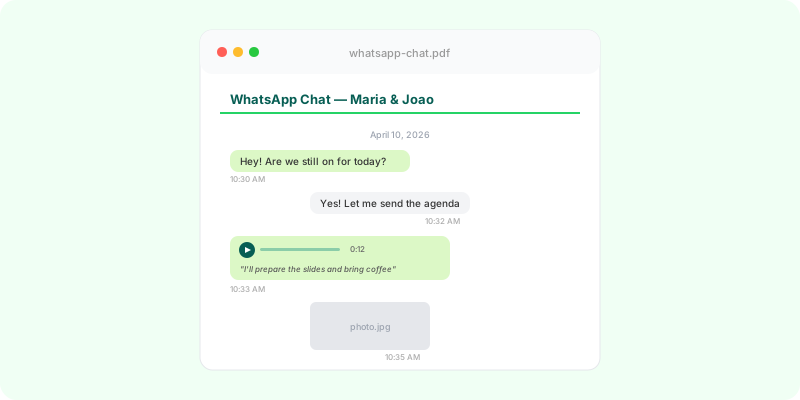
Court forms and advisers usually say “text messages”, whichever app they were sent in. What makes them usable is not the app — it is the form you bring them in:
- one continuous document, not a folder of images;
- the date, time and sender on every message, so the sequence is visible;
- photos and files where they were sent, not in a separate folder with names like
IMG-20260315-WA0042.jpg; - voice notes written out, if anything was agreed out loud;
- page numbers, so anyone in the room can be pointed at one message.
WhatsApp’s own export gives you a .txt file and a pile of separate media files, which has none of that. Export the chat with media (Android, iPhone), then upload the .zip to Zap2Doc and you get a single PDF for the date range you choose: every message in order with sender and timestamp, photos in place, voice notes transcribed where they were sent, and numbers — amounts, account numbers, order references — reproduced exactly as they were typed. Most conversations are ready in under a minute. See a sample PDF explained part by part.
If you need it on paper, see how to print a chat.
4. Put the rest of the bundle around it #
The conversation is usually the spine of a small claim, but rarely the whole of it. Alongside it, gather:
- the invoice, quote, order confirmation or receipt;
- bank or card records showing what was paid and when;
- photos of the goods or the work, with the dates they were taken;
- any letter or email you sent asking for the problem to be fixed, and the reply;
- delivery or tracking records.
Keep these as separate documents rather than merging them into one file. A judge reading a bundle wants to see what kind of thing each item is.
5. Label, number, copy #
Three mechanical steps that cost nothing and save the hearing:
- Label each document — a short name and a number is enough. Many courts call these exhibits and have their own convention; use theirs if they have one.
- Make sure every page is numbered. This is the difference between “he said he’d refund me, it’s in there somewhere” and “page 34, 14:07”.
- Make the copies. Usually one for the court, one for the other side, one for you — but check, because the number and the deadline for filing both vary, and a bundle that arrives late may not be read.
6. Keep the original #
The PDF is the copy people read. The export .zip and the phone are what it was made from, and you should still have both. Don’t edit the .zip, don’t rename files inside it, and don’t delete the chat from the phone while the matter is open.
What the document is, and what it isn’t #
The PDF is an ordered presentation of the export you supplied. It is not authentication, a forensic report, a chain of custody, a certificate, or legal advice. The cover shows the SHA-256 of the export it was built from, which identifies that exact file — it does not show that the export is unaltered or that the account belongs to who you think it does.
For the general version of this, across any forum, see how to organize WhatsApp messages as evidence. If a lawyer is involved, organizing WhatsApp chats for lawyers describes the same job from their side.