WhatsApp PDF with Voice Transcription: The Complete Guide
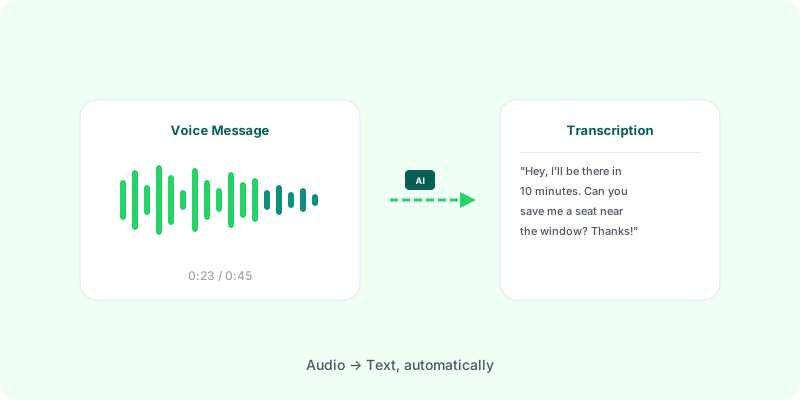
Most tools that convert WhatsApp chats to PDF skip the voice messages entirely — or list them as .opus files you’d have to play manually. That defeats the point of having a searchable document.
A proper WhatsApp-to-PDF tool transcribes every voice note in the chat and embeds the text directly in the PDF, in order, alongside the regular text messages.
Here’s how that works and why it matters.
Why Voice Transcription Belongs in the PDF #
WhatsApp voice notes are often the most important content in a conversation:
- Agreements and commitments — verbal “yes, I’ll send the money” or “we agreed on Friday”
- Detailed explanations — context that the sender typed too quickly to capture in text
- Names, numbers, addresses — easier to speak than to type on mobile
- Tone and intent — hesitation, agreement, emphasis
If your PDF archive doesn’t capture this, you’re missing roughly 30-50% of the actual conversation in most modern WhatsApp chats. Speaking has become the default for anything longer than a sentence.
What Voice Transcription Looks Like in Practice #
A well-built PDF with transcription places each voice note in the conversation flow, with the transcribed text right below the audio entry:
[14:32] Maria: I'm sending the documents tomorrow morning
[14:33] Maria (Voice 1:24): "Hi, just a quick update — the contract is
        signed, I'm sending it to your email by 9 AM Friday. The
        delivery date is the 28th, not the 25th like we said before,
        because of the holiday. Let me know if that's a problem."
[14:35] You: Got it, no problem with the 28th
This way, the conversation reads top-to-bottom as one document. You can search for “Friday” or “contract” or “28th” and find every mention, whether it was typed or spoken.
What Transcription Engine Should You Use? #
For WhatsApp voice messages, the realistic options are:
- OpenAI Whisper — the current state of the art for short-form multilingual audio. Auto-detects 50+ languages. Handles noisy phone audio reasonably well. This is what Zap2Doc uses.
- Google Speech-to-Text — accurate but requires you to specify the language upfront. Not great for multilingual chats.
- Deepgram Nova-3 — competitive accuracy with word-level timestamps. Used by some commercial tools.
- AssemblyAI — solid for English, weaker for non-English.
For WhatsApp specifically, Whisper’s automatic language detection matters: most real chats switch languages or mix in slang/code-switching, and Whisper handles that without you having to configure anything.
How Long Does Transcription Take? #
For a typical WhatsApp chat with 30-60 minutes of total voice notes, transcription takes about 2-5 minutes end-to-end. That includes:
- Extracting
.opusaudio files from the.zipexport - Sending each file to the transcription engine
- Stitching the transcripts back into the chat timeline
- Generating the final PDF
Some tools do this on demand (you wait while it runs); others do it asynchronously and email you when it’s done. Either way, expect a few minutes for an average conversation.
Language Detection: Why It Matters #
WhatsApp doesn’t tag voice messages with the spoken language. The transcription tool has to figure it out from the audio itself.
For monolingual chats (everyone speaks the same language), this is straightforward. For mixed-language conversations — common in business chats, family groups, or multilingual regions — automatic detection per-message is the only thing that works.
Whisper does this well. Tools that require you to set “the chat language” upfront fail here.
What About Audio Quality? #
WhatsApp voice notes are encoded as Opus at low bitrates to keep file sizes small. This is fine for human listening but can challenge older speech engines.
Modern engines like Whisper are trained on similar low-quality audio and handle it well. Expect roughly 90-95% word accuracy on clear voice messages; lower (75-85%) on heavy background noise, accents, or very quiet recordings.
A good PDF tool will still output the transcript even when accuracy is imperfect — partial text is more useful than nothing.
Privacy: Where Does the Audio Go? #
Voice transcription requires sending audio to a server (Whisper, Deepgram, etc.) — there’s no realistic on-device option that matches the quality.
Look for tools that:
- Delete the audio after transcription (no permanent storage of voice files)
- Use named transcription APIs (Whisper, Deepgram) rather than opaque “AI engines”
- Don’t train on your data — OpenAI and Deepgram both have policies against training on API-submitted audio
Zap2Doc sends audio to OpenAI’s Whisper API and deletes the source files automatically after the PDF is generated.
Putting It Together: One PDF, Fully Searchable #
The end result of a chat-plus-transcription workflow is a single PDF where:
- Every text message is preserved with timestamp and sender
- Every voice message is transcribed inline, in the right place in the timeline
- Every image and attachment is listed (and images rendered inline if it’s a media-heavy chat)
- The whole thing is text-searchable —
Ctrl+Ffinds any word, spoken or typed - Date filters and color schemes make it readable, not just a wall of text
This is what a serious archive of a WhatsApp conversation should look like — and it’s the gap most generic “WhatsApp to PDF” tools leave open.
Try It #
Export your chat from WhatsApp (Contact/Group Info → Export Chat → save the .zip), then run it through Zap2Doc. Voice transcription is included in the standard $5.99 price — no add-ons, no upsell tiers. You’ll get a single PDF with both text and audio fully captured.