Converting WhatsApp Chats to PDF for Legal and Business Records
WhatsApp Chats as Formal Records #
WhatsApp conversations now contain a substantial portion of everyday business and personal agreements: delivery dates, payment confirmations, contract terms, scope changes, decisions made between partners or with clients. When something goes wrong — a missed payment, a disputed delivery, a broken promise — the conversation history is often the clearest record of what was actually agreed.
Turning that conversation into a clean, organized PDF gives you a document that is easier to review, share with a lawyer, or submit alongside other records.
This guide covers what to include in a PDF intended for serious record-keeping, what limits to be aware of, and how to produce a document that holds up well to scrutiny — without overpromising what such a document can do.
What a Useful Record PDF Contains #
Whether the goal is a lawyer review, an internal audit, or just a clean archive for your own files, a well-built PDF of a WhatsApp conversation should include:
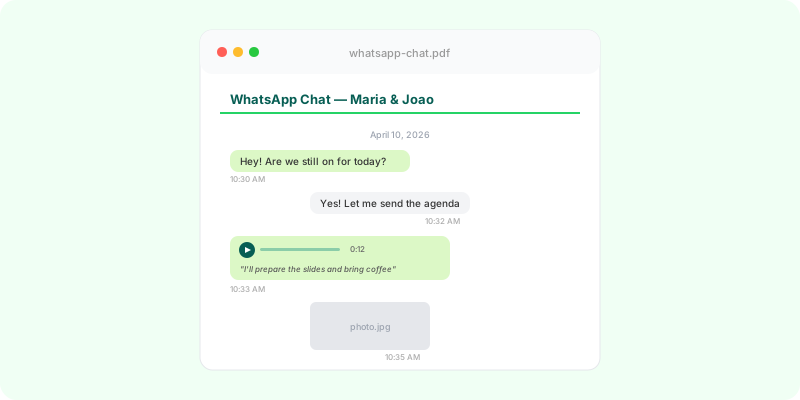
- Every message in chronological order, with sender names and timestamps
- The date range clearly marked at the top of the document
- Voice messages transcribed inline, not skipped or listed as separate files
- Images rendered inline where they appear in the chat, so context is preserved
- Document attachments listed with their original filenames
- A clean, neutral typography — easy to read, not styled like marketing copy
The export should reflect the conversation as it happened: no edits, no inserted commentary, no rearranged messages. A reader unfamiliar with the chat should be able to follow it from start to finish.
What WhatsApp Exports Already Give You #
WhatsApp’s native “Export Chat” function (Contact/Group Info → Export Chat) gives you a .zip containing:
- A plain
.txtfile with every text message, dated and timestamped - Original-quality images (or thumbnails, depending on export size)
- Voice message files in
.opusformat - Document and file attachments in their original formats
This raw export is technically complete, but it’s awkward to read. The .txt file mixes timestamps and content into long unbroken lines. Images are filenames, not pictures. Voice notes are unplayable in most viewers. Anyone reviewing it will spend more time decoding the format than reading the content.
A proper PDF conversion fixes this by laying out the conversation as a normal document and rendering the media inline.
What a PDF Does and Doesn’t Establish #
It’s worth being explicit about this: a PDF generated from a WhatsApp export is a presentation of the export data, not a forensic artifact.
What the PDF does:
- Presents the conversation in a readable, chronological format
- Preserves the message content exactly as it appears in the WhatsApp export
- Includes media (images, voice transcripts) in their original position
What the PDF doesn’t do on its own:
- It does not authenticate that the conversation occurred between specific people
- It does not prove who controlled the WhatsApp accounts at the time
- It does not establish chain of custody from your phone to the document
For formal legal proceedings, courts in most jurisdictions accept WhatsApp messages as evidence, but the specific requirements vary by country, court, and case type. The PDF is a useful presentation layer; the legal weight depends on additional steps (witness testimony, device authentication, metadata preservation, expert testimony in some jurisdictions). Talk to a lawyer in your specific jurisdiction before relying on any chat export for legal purposes.
Practical Tips for a Strong Record #
A few practical points that make a record PDF more useful:
1. Export as soon as possible. WhatsApp’s local storage of older messages can be lost (uninstalls, device changes, storage cleanups). Export while the data is current.
2. Export the full chat, not a selection. Selective exports invite questions about what was left out. Full exports are easier to defend.
3. Include media. WhatsApp gives you the choice “Without Media” or “Include Media” on export — for any serious record, include media. Images and voice notes often contain the most important content.
4. Note the export date. The PDF should show when the export was done, not just the conversation date range. This matters for chain-of-custody discussions later.
5. Keep the original .zip. The PDF is the readable version, but the original .zip from WhatsApp is the source. Keep both — never rely only on a derived document.
6. Don’t edit the PDF. Once generated, treat it as immutable. If you need to add commentary or context, do it in a separate document.
What Voice Transcription Adds #
Many of the most important moments in a WhatsApp conversation happen in voice notes: verbal agreements (“yes, send it”), specific terms (“we agreed on the 28th”), tone (hesitation, acceptance, refusal).
A PDF that includes transcribed voice notes captures these moments in text form, alongside the typed messages. This makes the document searchable, easier to quote, and faster to review. The original audio files are still in the .zip if anyone needs to verify the transcription.
Zap2Doc transcribes voice notes automatically using OpenAI’s Whisper, with the transcript appearing inline below each audio entry. No manual transcription, no separate audio playback required to follow the conversation.
Cross-Border and Multilingual Considerations #
For business or legal contexts that span borders, a few extras matter:
- Language: if the conversation is in Portuguese, Hindi, Arabic, or any non-English language, the PDF interface and structure should be in that language. A reader (or judge, or business partner) shouldn’t have to navigate English headers to read a conversation in their own language.
- Date format: clarity about timezone and date format (DD/MM/YYYY vs MM/DD/YYYY) avoids ambiguity.
- Right-to-left (RTL) text: for Arabic or Hebrew conversations, the PDF needs proper RTL layout — not just translated text dropped into a left-to-right template.
Zap2Doc supports 8 languages including Hindi (with court-relevant terminology for Indian users) and Arabic (with RTL layout for MENA users), so the document matches the language of the conversation it captures.
How to Generate a Clean Record PDF #
The workflow is straightforward:
- Export the chat from WhatsApp (Contact/Group Info → Export Chat → Include Media)
- Save the
.zipsomewhere stable (cloud storage, encrypted drive) - Upload to Zap2Doc — drag and drop the
.zip - Review the preview to confirm the date range and content
- Download the full PDF — voice notes transcribed, images inline, full chronology
The whole process takes about 2-5 minutes for a typical conversation. The resulting PDF is text-searchable, prints cleanly, and travels well as an email attachment.
Bottom Line #
A PDF generated from a WhatsApp export is the most practical way to make a conversation readable, shareable, and reviewable. It’s not a forensic certification, and shouldn’t be marketed as one — but for the vast majority of business and personal record-keeping needs, it’s exactly the right tool.
Pair it with the original .zip (for verification) and clear documentation of when and how the export was done, and you have a solid record. For specific legal questions about admissibility, jurisdiction, or authentication, talk to a lawyer in your region — every legal system handles digital messages a little differently.
Convert your WhatsApp chat to a clean PDF at Zap2Doc. Voice transcription is included.